
Skewer Along the Diagonal | Chess Puzzle for Kids
SkewerHard
White to move. Check the king along the diagonal, then win the piece behind it.
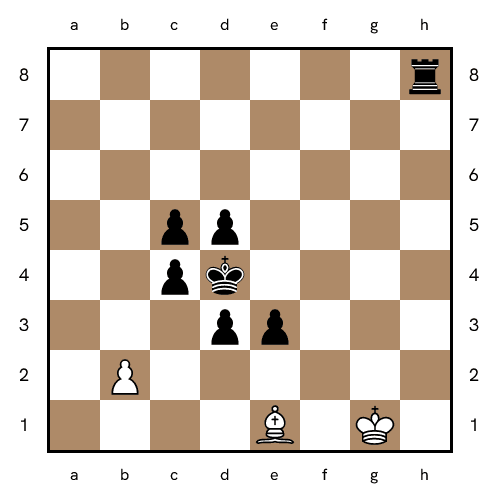
Starting position: White: King g1; Bishop e1; Pawn b2. Black: King d4; Rook h8; Pawns c4, c5, d3, d5, e3.
About this puzzle
There are 10 pieces on the board. White has a bishop and a pawn besides the king (4 points), and Black has a rook and five pawns besides the king (10 points). Black is ahead by 6 points, counting a pawn as 1, a knight or bishop as 3, a rook as 5 and a queen as 9.
- White's king on g1 has 5 squares next to it: none hold its own pieces and Black already attacks 3 (f2, h1, h2), so it can step to f1 and g2.
- Black's king on d4 has 8 squares next to it: its own pieces fill 5 (c4, c5, d3, d5, e3) and White already attacks 1 (c3), so it can step to e4 and e5.
White moves first and has 11 legal moves: one of them gives check, and none captures a piece. Checks and captures are the first moves to look at. Black's king on d4 can step to two squares right now.
The site has 5 Skewer puzzles, and all of them are hard. This one has the most pieces (10); the others have 6. White has fewer legal first moves than in any other Skewer puzzle (11).
Show how the solution works (spoiler)
A skewer attacks a valuable piece that has to move, then wins the piece standing behind it on the same line. Bc3+ checks the king, the king steps off the line, and the bishop takes the rook on h8.
- Bc3+: the bishop moves from e1 to c3. It gives check. From c3 it attacks the king on d4. No black piece can take it there.
- Ke4 is Black's only legal move: the king goes from d4 to e4.
- Bxh8: the bishop takes the rook on h8. No black piece can take it there.
The solution is two moves for White with one forced reply. White wins the rook on h8 (5 points) and loses nothing. After the line, Black is 1 point ahead.
New to these puzzles? Learn how to solve chess puzzles with a worked example.